護耆.ai (Wookay)
▶▶ ×4
RGB camera
Ordinary camera
What it reveals
Face, clothes
and your home
and your home
RGB inactive
Thermal Sensor
Body height
System alert
Monitoring
Thermal inactive
Radar
Radar · floor position
Movement
Radar inactive
TODAY
Fall detection
NEXT
Behavioural analysis
- Posture: standing, sitting, lying
- Activity level & time in bed
- Gait and mobility changes
- Changes in daily routine
160×120 thermal · Fall #1 · real recording
Skeleton is an AI estimate (illustrative)
Skeleton is an AI estimate (illustrative)
Direction AHigh-res skeleton160×120 thermal
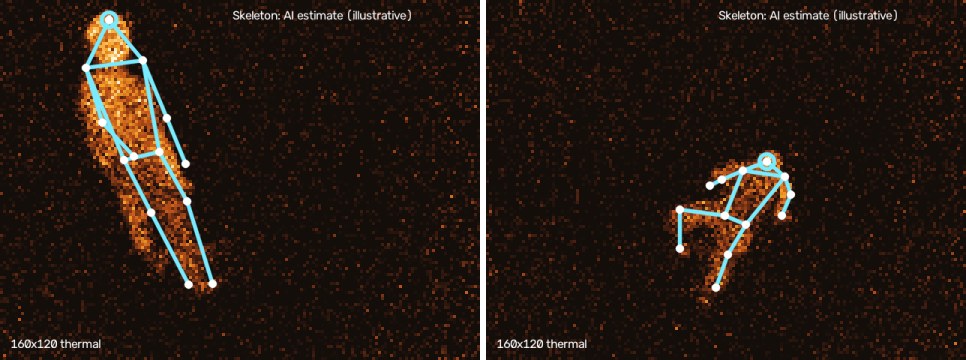
- Full skeleton — joints, posture, gait
- Lower training cost — existing pose models already work on standing frames
- Needs a stronger processor (25× the pixels of 32×24)
- More expensive sensor
Our study: an off-the-shelf pose model found the skeleton on standing 160×120 frames with no training; lying poses still need our own labelled data
Direction BLow-res state tracking32×24 thermal
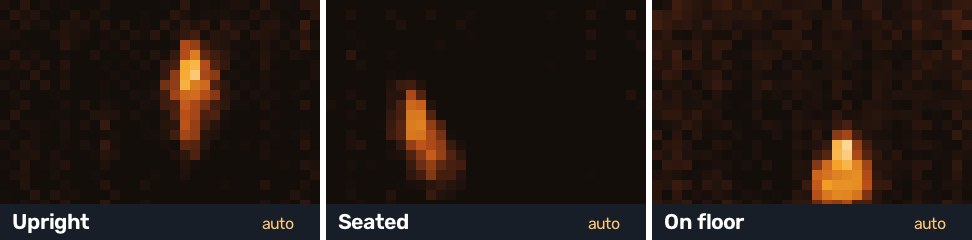
- Low-cost sensor that runs on a local processor
- No skeleton needed — classifies body state directly
- Follows the person's state over hours and days
- Needs broad training data to work in every new home
Our study: 91% of 2-second windows classified correctly (1 person, 1 room)
Low-res works at scale: TaFall (arXiv 2026), 35 people — 98.26% fall detection, 0.00126% false alarms over 27 days in 4 homes
Low-res works at scale: TaFall (arXiv 2026), 35 people — 98.26% fall detection, 0.00126% false alarms over 27 days in 4 homes
32×24 · automatic
What happened
annotated
annotated
UprightSeatedOn floor▼ FallBlank in the annotated row = transitions, not scored
Upright
Seated
On floor
Longest on floor
Falls seen as "on floor"
Windows correct
From minutes to months: time in bed · night-time activity · changes in daily routine · slowing mobility
One person, one room, 20-minute real recording. The automatic row judges every 0.5 s; totals come from it. Accuracy is scored only where annotated. Each segment is judged by a model that never trained on it (3-fold cross-validation).